
Lenses · 58 mm f/2 · Soviet Union
Helios 44
The fifty-dollar Soviet lens that shot a Batman car chase. Openly a Zeiss Biotar, slightly wrong in all the right ways.
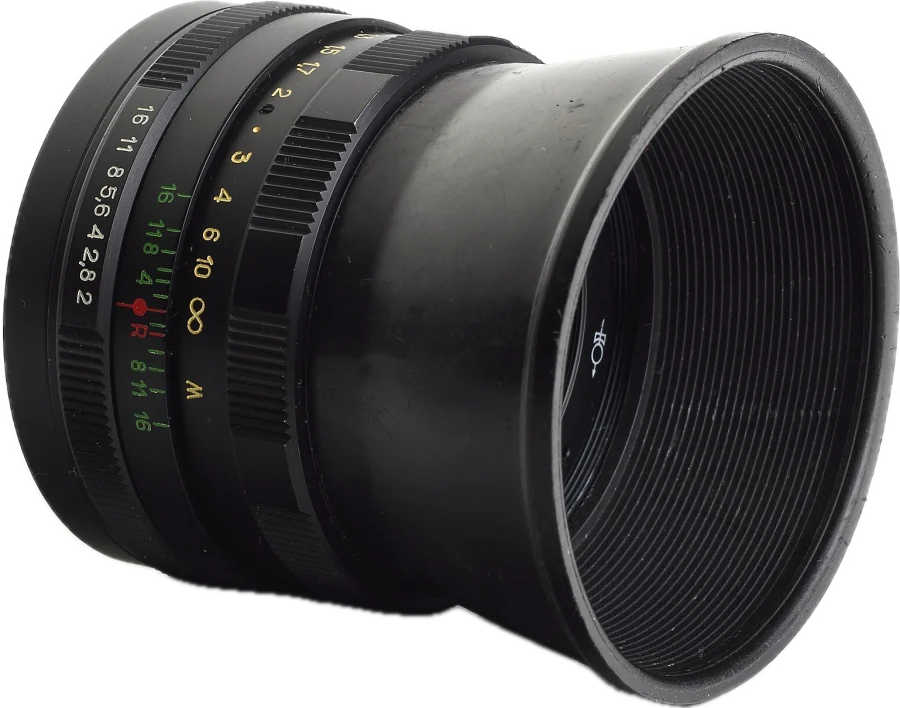
Photo: Dmitry Makeev · CC BY-SA 4.0 · Wikimedia Commons, background removed

Specifications
- Focal length
- 58 mm
- Maximum aperture
- f/2
- Optical design
- Six-element anastigmat after the Biotar, 6 elements in 4 groups
- Angle of view
- 40°28′
- Minimum focus
- 0.5 m (0.7 m on the Start version)
- Filter thread
- 49 mm (44, 44-2), 52 mm (44M series)
- Weight
- About 230 g (44, 44-2) to 300 g (44M-4)
- Aperture blades
- 13 or 8 (44), 8 (44-2, 44-3, 44M), 6 (44M-4 and later)
- Mounts
- Start bayonet, M39, M42, Pentax K (44K-4)
- Designed / made
- Designed 1953, first called БТК (“BioTar Krasnogorsky”); made from 1958
Archive figures
By the numbers.
- Focal length
- 58 mm (58.60 mm)
- Maximum aperture
- 1:2
- Angle of view
- 40°28′
- Frame size
- 24×36 mm
- Elements / groups
- 6/4
- Closest focus
- Helios-44 (Start) — 0.7 m; other versions — 0.5 m
- Aperture range
- 1:2–1:22, 1:2–1:16
- Filter thread
- Helios-44 (Start) — SpM40.5×0.5; Helios-44 — M49×0.5; Helios-44-2 — M49×0.75; Helios-44-7 — M49×0.5; Helios-44X-x — M52×0.75
- Weight
- Helios-44 (Start) — 0.23 kg
Source: ZENITcamera archive, Helios-44 (in Russian), read 15 November 2026. Fields the archive leaves out are left out here.
How it draws
Character.
The swirl
Field curvature: the lens focuses on a slightly curved surface instead of a flat plane, so towards the edges the background bends and spins. To its designers it was a flaw; on screen it is the look.
Warmth and imperfection
Greig Fraser praised the warmth and the lack of uniformity across the image: a lack of scientific perfection.
Flare and blades
Early single-coated lenses flare easily, with a blue-purple cast. Stopped down, 13 blades keep out-of-focus highlights round; 8 and 6 blades start to show their shape.
On screen
Films shot with it.
 Film · 2024 · Greig Fraser
Dune: Part Two
The desert and Paul’s story; three of themRead the article →Photo: Anil Öztas · CC BY-SA 4.0 · Wikimedia Commons

 Film · 2023 · Greig Fraser and Oren Soffer
The Creator
Select shotsRead the article →Photo: Gage Skidmore · CC BY-SA 3.0 · Wikimedia Commons

 Film · 2022 · Greig Fraser
The Batman
Car chase, cameras bolted to the carsRead the article →Photo: Lyn Fairly Media · CC BY 3.0 · Wikimedia Commons

Looks
Through the glass.
Test footage
Coming
Our own test footage: wide open against stopped down, flare into the light, skin tones.
Versions
Which one is which.
Helios-44 (Start)
from 1958
Start bayonet
The first version, for the Start camera, with an external aperture drive. 13 blades, focuses to 0.7 m, 40.5 mm filter.
Helios-44
c. 1958–1970
M39
Preset aperture, 13 blades on early silver KMZ lenses, 8 on later black ones; MMZ made silver and “zebra” versions. Early ones close to f/22, later to f/16. 49 mm filter, about 230 g.
Helios-44-2
c. 1969–1990s
M42
Preset aperture, 8 blades, 49 mm filter, about 230 g. Made by KMZ, MMZ (BelOMO) and the Jupiter plant in Valdai. The usual swirl favourite.
MC Helios-44-3
1980s–1990s
M42
MMZ’s own multi-coated version in a different barrel, numbered -3 to tell it apart from the 44-2. Preset, 8 blades. A 44-3M macro version exists. The older barrel sits deep in some adapters.
Helios-44-7 / 44D
late 1960s–1970s
Zenit-7 / Zenit-D only
Kit lenses for the Zenit-7 and Zenit-D with their own aperture drives, so they only work on those cameras (the 44-7 via an adapter ring). The 44-7 weighs about 350 g.
Helios-44M
1970s–1980s
M42
Automatic aperture (M) with an A/M switch, 8 blades, 52 mm filter, about 270–300 g. Finished development at KMZ in 1972. Also sold as the Auto Cosmogon.
Helios-44M-4 / MC 44K-4
from 1981 / 1987
M42 / Pentax K
Automatic aperture, 6 blades, about 300 g (44K-4: 258 g). Moved from Krasnogorsk to the Jupiter plant in Valdai in the late 1980s.
MC Helios-44M-5 / -6 / -7
c. 1990–late 1990s
M42
Valdai lenses sorted by measured resolution: the sharper the batch, the higher the number. 6 blades, multi-coated, about 270 g. Some 44M-7s have a protruding rear that can foul a DSLR mirror.
Tools
Watch
Is the Helios 44 Secretly a Zeiss? The Truth Is Worse
Buying one
Before you buy.
Which version
The preset 44-2 (8 blades) is the classic choice for swirl and the easiest to find. The early 13-blade silver lenses keep highlights rounder stopped down but flare more. Later M-series lenses have 6 blades.
What to check
Haze, fungus and scratches on the glass; a smooth focus ring; oil on the aperture blades; that the aperture actually stops down. Parts were often swapped between lenses, so a mixed lens is common.
Adapting
M42 adapts easily to mirrorless mounts with a simple ring; M39 needs an M39-to-M42 step ring first. The Start, 44-7 and 44D versions won’t work on ordinary adapters. Some 44M-7s and early lenses can hit a DSLR mirror.
Where to buy · coming
Tested copies from us, and links to trusted sellers. Any affiliate link will be clearly marked as one.
References
- ZENITcamera archive: Объектив Гелиос-44 (Helios-44 lens)Russian Zenit archive built on KMZ catalogues, manuals, technical specifications and factory orders. Source for design, focus, filter, weight, blades and dates.
- no-X et al., “Complete list of Helios lenses”, MFlenses forum (2010–2025, 18 pages)Collector-compiled list and discussion. Source for versions, factories and serial-number patterns; the thread itself disputes several of them.
- American Cinematographer: The Creator: Hope for the FutureLists the lenses of The Creator (2023), including Iron Glass-rehoused Soviet lenses.
- Phillip Reeve, “Review: KMZ Helios-44 58mm 2.0”Hands-on review of an early silver M39 lens (13 blades, 222 g, 0.5 m, 49 mm).