
Shot on · 2019
The Lighthouse
Baltar lenses from the early 1940s in a nearly square frame, on black-and-white Double-X film, with three Petzval-type lenses that Panavision’s Dan Sasaki made for the film.
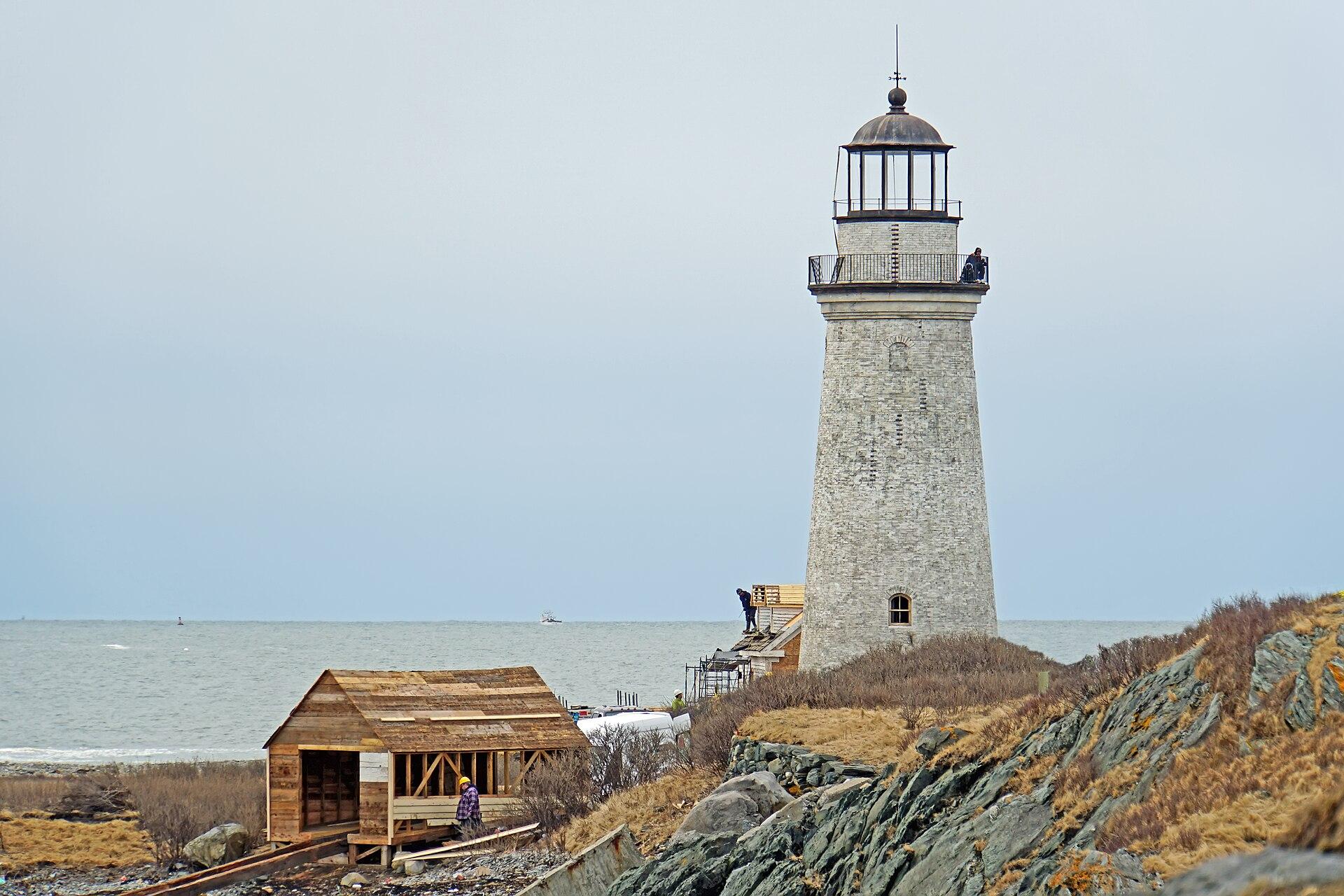
Photo: Dennis G. Jarvis · CC BY-SA 2.0 · Wikimedia Commons

The lenses
The main lenses were Baltars: an American design from the 1930s. The set on this film carried serial numbers dated between 1941 and 1944.
For heightened moments and flashbacks there were three Petzval lenses, a design that goes back to 1840, made by Dan Sasaki at Panavision. He already had a 58 mm and an 85 mm. Jarin Blaschke uses a 35 mm a lot and asked whether one could be made, and Sasaki made it.
Why those
Blaschke wanted to find out how much character a lens could bring before the picture tipped from transporting into kitsch. He asked Panavision for old lenses that were not on the menu, and tested Cooke Series 1s, a deliberately detuned modern lens, an uncoated triplet from 1905 and the Baltars.
The Baltars won. He calls them the most glowing portrait lenses he had seen, without going too soft or flaring too much, and he singles out the way highlights shimmer. They also let through a lot of blue and ultraviolet light, which suited the look he was after.
The Petzvals swirl the out-of-focus background, more heavily towards the edges. Blaschke says plainly that it is not a subtle effect, which is why they were kept for a few moments only.
The camera and the film
A Panavision Millennium XL2, loaded with Kodak Double-X, a black-and-white negative stock.
Early photographs could only record blue and ultraviolet light, which is why their skies are blank and white and skin looks dark. To get that back, Blaschke first tried ordinary filters. The ones strong enough cost three to four stops of light, which is unworkable anywhere but outdoors in daylight. In the end Schneider Optics made him a custom filter to a curve he had sketched on graph paper: everything redder than mid-yellow cut away, everything bluer let through.
The nearly square frame
The film is 1.19:1. Robert Eggers wrote the shape on page one of the script, next to the demand for 35 mm black-and-white film.
Blaschke says Eggers does not see things in widescreen. Their first two shorts were 1.33:1. The Witch was 1.66:1, the boxiest frame they thought a first feature could have and still find a distributor. Nobody objected to the square frame on The Lighthouse. The black and white was the harder sell.
Who shot it
Jarin Blaschke, on his second feature with Eggers after The Witch. He has shot all of Eggers’ features since.
How it did
The Lighthouse premiered at Cannes in May 2019. It cost $11 million and took $18.3 million worldwide.
Blaschke was nominated for the Academy Award and the BAFTA for best cinematography.
Worth knowing
Robert Pattinson has said he thinks the film is entirely a comedy, and that he tried to have it entered as one for the Golden Globes.
Blaschke, for his part, says Eggers’ taste in books stops before the twentieth century, and that he has spent years trying to get him to read Hemingway.
Watch
Behind the scenes.
From Film Independent · 62 min
Robert Eggers shares his design book for The Lighthouse
From Panavision · 59 min
Jarin Blaschke and Dan Sasaki on the lenses of the Eggers films
From Film at Lincoln Center · 51 min
Robert Eggers on The Lighthouse and its aspect ratio
From A24 · 2 min
The Lighthouse: the world
The lenses, at a glance
Baltar
Designed in the 1930s; this set’s serial numbers dated from 1941 to 1944
Lens File: Baltar →Custom Petzval optics
Three lenses made by Dan Sasaki at Panavision
Lens File: Petzval →
Read more
The film
- Cinematographer
- Jarin Blaschke
- Director
- Robert Eggers
- Set in
- 1890
- Aspect ratio
- 1.19:1
- Camera
- Panavision Millennium XL2
- Film stock
- Kodak Double-X, black and white
- Budget
- $11 million
- Box office
- $18.3 million worldwide
- Awards
- Oscar and BAFTA nominations for cinematography
Sources