

Cinema Myths · Case 01
“In 1896 the audience ran screaming from the Lumière brothers' train.”
Nobody ran from the Lumière train
It is in every film book and taught in film school. There is not a single piece of evidence that it happened.
The verdict
Myth: Guilty
No panic was ever reported. The audience of 1896 knew it was shadows and flinched anyway, which is still the whole trick of cinema. The only person on record who panicked at a screen train was an actor, and he was paid to.
The case file
Exhibits, suspects, verdict.
Exhibit 1
The train wasn't there
Sourced in episodeThe myth places the panic at the first public Lumière screening in Paris on 28 December 1895. The programme still exists: ten films, among them workers leaving a factory, a baby eating breakfast and a gardener sprayed with a hose.
The train is not on the list. The biggest panic in film history, and the main character didn't show up.
Exhibit 2
The newspapers
Sourced in episodeThen it must have been January, when the train was shown. Film historian Martin Loiperdinger read the newspapers of the time. A packed, dark room and a crowd rushing one narrow door would mean people trampled, which is front-page news.
He found nothing. Not one line about a panic.
Exhibit 3
The eyewitness
Sourced in episodeIn the summer of 1896 Maxim Gorky saw the film and wrote that the train seemed to rush straight at him. In the same review he called it a train of shadows: silent and grey. Not scared; a little disappointed.
That is what all the sources look like. People flinched, but not one confirmed person believed the train was real. Tom Gunning compares it to a roller coaster: you scream, but you don't think you're going to die.
An editor's look
Why they flinched
Sourced in episodeThe camera stands at an angle, close to the edge of the platform. The train starts as a dot and grows along a diagonal until it fills half the frame: movement straight into the lens, the same trick every action film still uses.
Then the passengers walk towards the camera and grow in frame. The close-up doesn't exist yet, so Lumière lets people walk into one. None of them look into the lens, and several are Lumière's relatives. It is directed: the first extras in film history.
Suspect 1
The marketing department
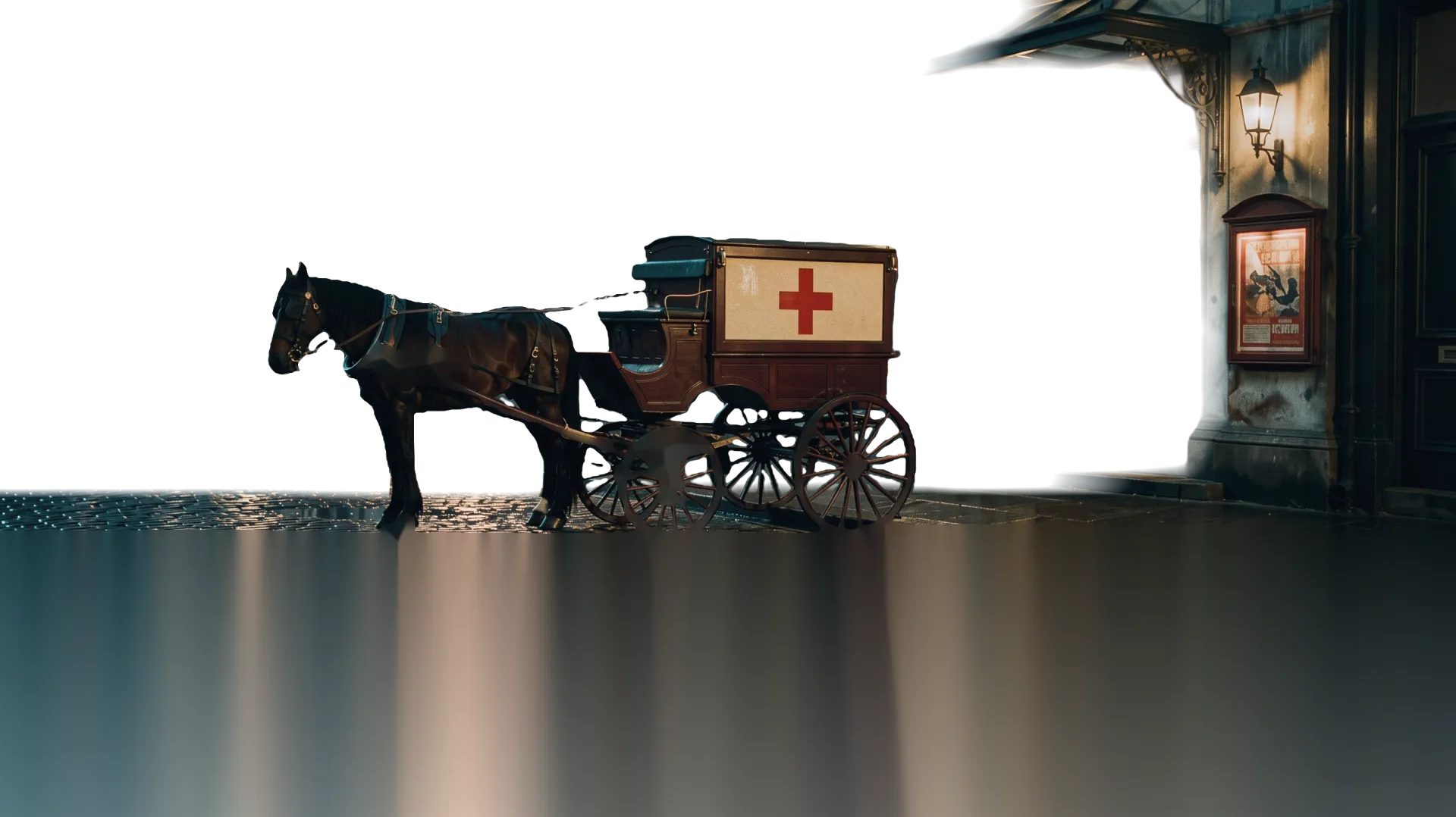
Sourced in episodeIn America the copycats arrived, among them The Black Diamond Express. One of the men behind it later wrote in his memoirs that two women fainted and that the theatre owner parked an ambulance outside every show.
Historians suspect a publicity stunt: one of the best trailers ever made, without a single frame of the film.
Suspect 2
Uncle Josh
Sourced in episodeIn 1901 R. W. Paul made a small comedy about a countryman at the cinema; a year later Edison's company remade it as Uncle Josh at the Moving Picture Show. Josh dances along with a dancer, dives for cover from a train and finally tears down the screen.
The joke is how clueless he is, and the audience laughs because they know the train isn't real. According to Loiperdinger this may be where the myth was born: a joke about one clueless viewer slowly became a history lesson about all of them.
For the defence
Montparnasse, October 1895
Sourced in episodeTwo months before the films premiered, a train's brakes failed at Gare Montparnasse and the locomotive went through the station wall and down into the street. There is a photograph, and it looks like an AI image. It is not.
It doesn't prove a panic, but Parisians had fresh reasons to sit a little further back.
Verdict
The myth: guilty
Sourced in episodeFor more than a hundred years we have told this story to show how gullible people used to be, and we fell for it ourselves: film books, film schools, all of us, without a shred of evidence.
Louis Lumière wasn't done with his train either. In the mid-1930s he shot the scene again, in 3D.
Sources
- Martin Loiperdinger, “Lumière's Arrival of the Train: Cinema's Founding Myth”, The Moving Image 4:1 (2004)
- Tom Gunning, “An Aesthetic of Astonishment: Early Film and the (In)Credulous Spectator” (1989)
- Stephen Bottomore, “The Panicking Audience? Early Cinema and the ‘Train Effect’”, Historical Journal of Film, Radio and Television (1999)
- Maxim Gorky, review in Nizhegorodski Listok, July 1896
- Archive footage: L'arrivée d'un train à La Ciotat (Lumière, 1896); The Countryman and the Cinematograph (R. W. Paul, 1901); Uncle Josh at the Moving Picture Show (Edison, 1902); Black Diamond Express (Edison, 1896) — all public domain
Sources as listed in the episode description. Archive footage is public domain.
More cases