
Anamorphic: stretched lights and blue streaks
One 1970s Kowa shot nearly all of The Creator. The Batman had anamorphics tuned for it, sharp in the centre and soft at the edges. Licorice Pizza chose a 1968 design for the blue flare it throws when a light hits it.
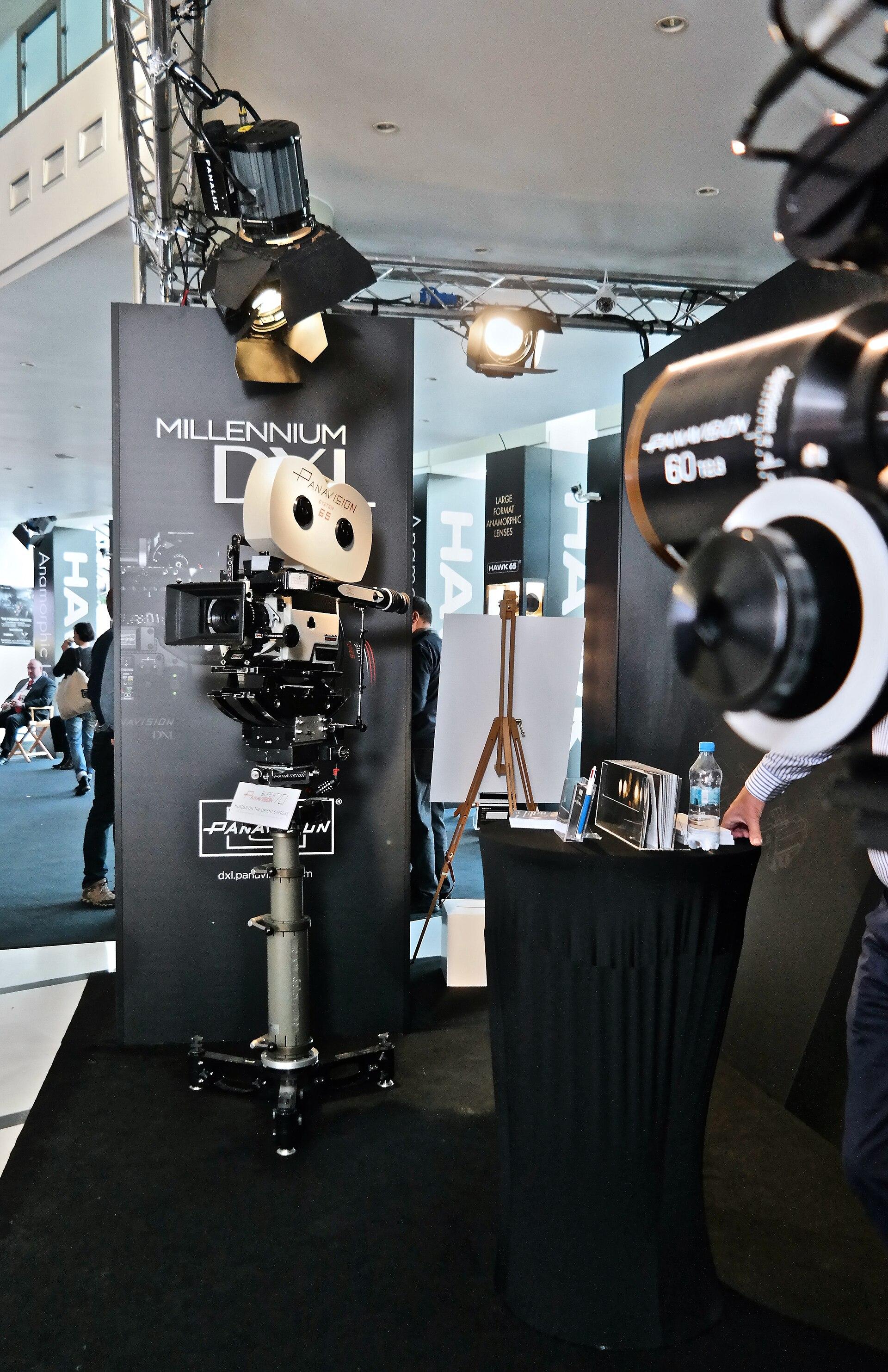
Photo: Karolina Plotnicka · CC BY-SA 4.0 · Wikimedia Commons

The Creator (2023)
Nearly the whole film went through one lens, a 75 mm Kowa anamorphic on a Sony FX3. A handful of rehoused Soviet lenses, a Helios 44-2 and a Jupiter-9 among them, came out for select shots.
The Batman (2022)
For the car chase, Fraser needed cameras bolted to cars. His main lenses were too big, heavy and expensive to crash, so rehoused Soviet Helios and Jupiter lenses went on the rigs, some with an oval cut into the aperture for anamorphic-looking bokeh.
The tuned Alfas are sharp in the middle and fall apart towards the edges: astigmatism, uneven focus, some smearing at the sides. Fraser wanted exactly that. He and director Matt Reeves were not going to place characters at the far edges of a wide frame, as a Sergio Leone western does. They would keep people near the centre and let the edges go.
On the chase the Alfas were no use. The cameras had to be bolted to cars, with faces pushed out to the sides of the frame, and the Alfas were too soft at the edges, too big and too heavy. Fraser wanted lenses with character that were small, light and cheap enough to lose in a stunt.
Licorice Pizza (2021)
For a film set in the 1970s, the main lenses were Panavision C Series anamorphics, and through Panavision’s Dan Sasaki the filmmakers found a set that Gordon Willis had once used.
For the blue streak that an anamorphic lens of that era throws across the frame when a light hits it. The film is set in the 1970s, and Manhattan, with Willis’s photography, was one of the films the two studied.
What an anamorphic lens does
It squeezes the picture sideways as it is recorded, traditionally by two to one, and the picture is stretched back out when it is shown. The squeeze comes from glass curved like a cylinder instead of a sphere, so it acts in one direction only.
That one-directional squeeze is where the look comes from. Lights that are out of focus are narrowed sideways and become upright ovals. A bright light throws a streak across the frame, because the squeezed direction bends light more strongly.
It is also where the wide screen comes from. A two-to-one squeeze on 35 mm film first gave a picture 2.66 times as wide as it was high. That was standardised to 2.35:1 in 1957 and to 2.39:1 in 1971.
Lenses built for The Batman
The Alfa lenses began with a request from Greig Fraser for new anamorphics that would cover a large sensor. ARRI Rental and ARRI took sets of the company’s Master Anamorphics, adapted them to the larger format and changed them inside to get the picture he asked for. The German cinematographer Nikolaus Summerer helped with further prototypes.
ARRI Rental describes the result as softer and more textured than the lenses they started from.
The C Series and its flare
Panavision dates the C Series to 1968 and describes it as compact and light, suited to hand-held work, with a pronounced flare. The colour of that flare comes from Kodak’s interview with Michael Bauman, who points to the blue streak in the golf-course motorcycle stunt in Licorice Pizza.
A gentler squeeze
Not every anamorphic squeezes by two. The Atlas Mercury series, whose 42 mm prototype covered the tight spaces on The Creator, squeezes by one and a half.
Watch
Behind the scenes.
From ShotDeck · 133 min
The Creator: Gareth Edwards, Greig Fraser and Oren Soffer in conversation
From Dolby · 64 min
The cinematography of The Batman
From Amazon MGM Studios · 2 min
Licorice Pizza: behind the scenes, a first look
The films
Sources
- American Cinematographer: The Creator: Hope for the Future
- Filmmaker Magazine: The Focus Pulling Olympics: DP Oren Soffer on The Creator
- Wikipedia: The Creator (2023 film)
- American Cinematographer: Truth in the Image: Greig Fraser, ASC, ACS
- Wikipedia: The Batman (film)
- British Cinematographer: Michael Bauman & Paul Thomas Anderson / Licorice Pizza
- Wikipedia: Licorice Pizza
- American Cinematographer: Practical Optics 3: Introduction to Anamorphic
- Cooke Optics: An introduction to anamorphic lenses
- Panavision: Alice Brooks and Dan Sasaki on anamorphic lenses
- ARRI Rental: ALFA and Moviecam lens series (press release)
- ARRI Rental: ALFA lenses
- Panavision: C Series anamorphic primes
- Kodak: Licorice Pizza
- Newsshooter: Atlas Lens Co. Mercury 1.5x anamorphic, first look (2022)