
Articles · Super-Takumar 50 mm f/1.4
Yes, some old lenses are radioactive
Hold a Geiger counter to the back of an old Takumar and it goes off. How much radiation that really is, which lenses have it, whether the Takumar is the worst, and the one place where it is a real problem.
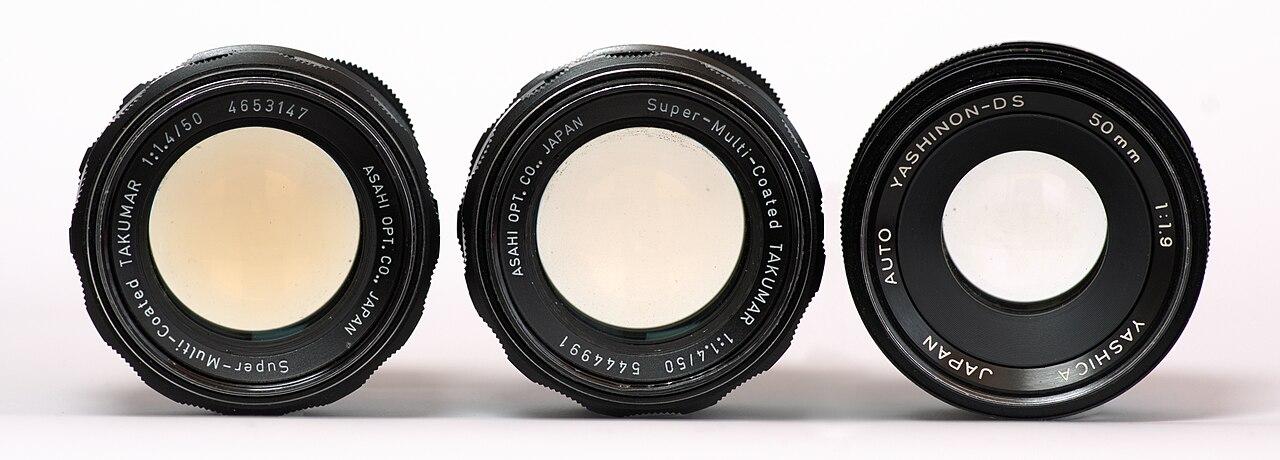
Photo: El Grafo · CC BY-SA 4.0 · Wikimedia Commons
The claim
One owner pressed a Geiger probe against the rear glass of his Takumar 50 mm f/1.4 and counted for ten minutes. The room gave 28 clicks a minute. The lens gave 26,838.
So the first half of the claim is true. Some vintage lenses are radioactive, a cheap instrument will show it, and the Takumars are among them.
The second half is that they are dangerous. A click is not a dose, and the dose estimates we could find say no, not in ordinary use: a photographer who carries such a lens gets a small fraction of what everyone gets from nature anyway. There is one exception, and it is not a camera lens. It is an eyepiece.
Why anyone put thorium in glass
A lens designer wants glass that bends light strongly, because a lens can then be thinner and lighter. Glass that bends light strongly usually also splits it into colours. Adding thorium gave a refractive index above 1.6 while keeping that colour spread low.
Two general patents for optical glass with thorium were issued in 1939. Paul De Paolis of Kodak applied for a patent with specific recipes in August 1945, and it was granted on 5 April 1949. One of those recipes was 12 percent thorium by weight. Later glass held up to 28 percent thorium oxide.
The museum of radiation at Oak Ridge Associated Universities, which keeps one of these lenses in its collection, reckons the first commercial ones appeared in the 1950s and that production seems to have ended in the late 1980s. They went into 35 mm cameras, television cameras, aerial cameras, military optics and microfilm readers.
The glass that replaced it uses lanthanum. Lanthanum is very slightly radioactive too, but one estimate puts its glass at about a ten-thousandth of thorium glass.
Which lenses
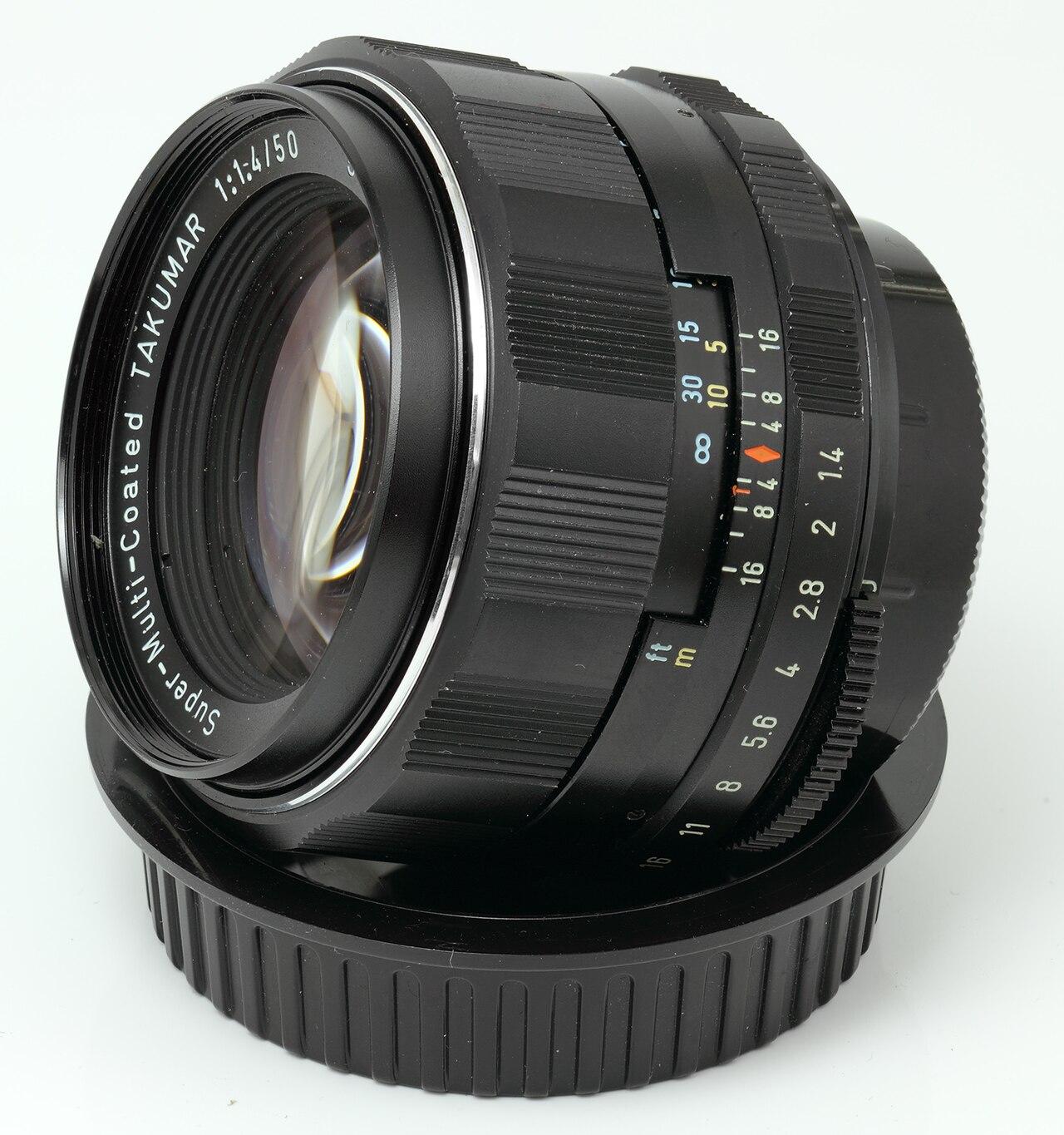
Asahi’s Takumars are the ones people name first, and they are on the Oak Ridge museum’s list: the Super-Takumar 35 mm f/2, 50 mm f/1.4, 55 mm f/1.8 and 55 mm f/2, the SMC Takumar 50 mm f/1.4, the Super-Takumar 6×7 105 mm f/2.4 and the Super-Multi-Coated Macro-Takumar.
The same list has the Canon FL 58 mm f/1.2, the Yashinon-DS 50 mm f/1.7, and several Kodak lenses on ordinary family cameras: the Ektanar 38 mm f/2.8 on the Instamatic 804, the Ektanon 46 mm f/3.5 on the Signet 40 and the Ektanon 50 mm f/3.9 on the Bantam RF. The museum calls these a few of many.
Cinema has them as well. Cooke says its Speed Panchro Series II, which arrived from 1953, used thorium dioxide in the glass, and it names Some Like It Hot, Goldfinger and Marnie among the films of that series. John Walker measured a Leica Summicron 50 mm f/2 from 1952 and found it radioactive, and he counts Kodak’s wartime Aero-Ektar aerial lenses among the well-known cases.
A list like this names models, not individual lenses. We have not found a reliable source that says which production runs of a Takumar have the thorium element and which do not, so we do not repeat what collectors say about that. A Geiger counter settles it for the lens in your hand.
Is the Takumar the worst?
It has that reputation. The best comparison we found is one owner’s: a collector who goes by s58y on Wikimedia Commons measured more than twenty of his own lenses with Ludlum survey instruments, ten minutes a reading, and published the numbers with his photographs. He calls the measurements informal and unscientific, and they cover one copy of each lens. They still put the lenses side by side on the same instrument, which nothing else we found does.
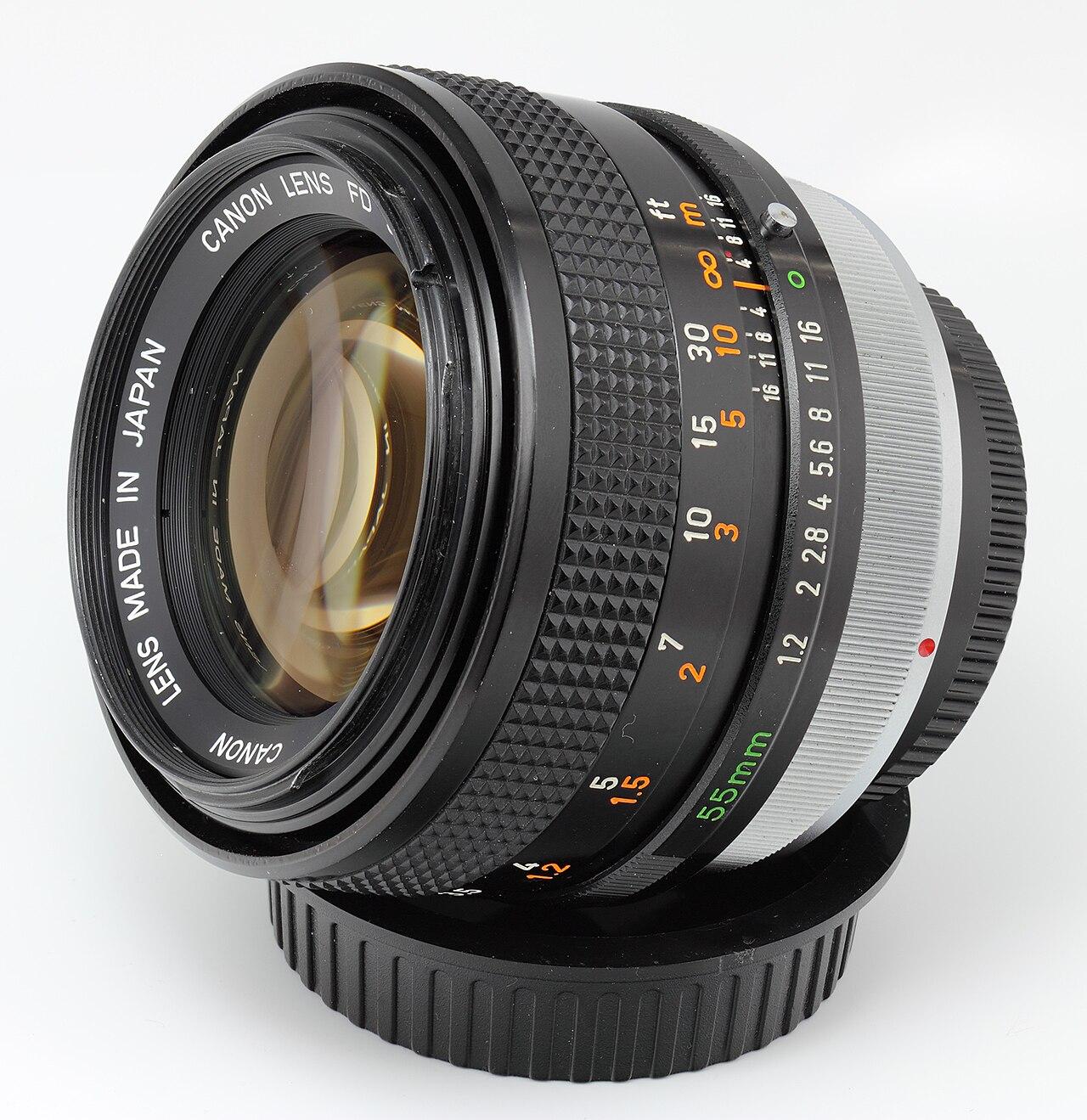
At the glass, three of his lenses beat the Takumar 50 mm f/1.4: a Konica Hexanon AR 57 mm f/1.2 at one and a half times its count, an early Fujinon 50 mm f/1.4 at 1.3 times and a Canon FD 55 mm f/1.2 S.S.C. Aspherical at 1.2 times. Ten centimetres from the side of the lens, with a probe that reads gamma rays, the Canon came out highest, at almost twice the Takumar.
The other Takumars sat below it. The 35 mm f/2 gave 70 percent of the 50 mm’s count at the glass and the 55 mm f/1.8 gave 64 percent. At ten centimetres the 55 mm f/1.8 was down to a fifth.
So in this collection the Takumar 50 mm f/1.4 is near the top, not at it. The fast lenses lead the table: every lens above it is an f/1.2 or an f/1.4.
What a plastic cap does
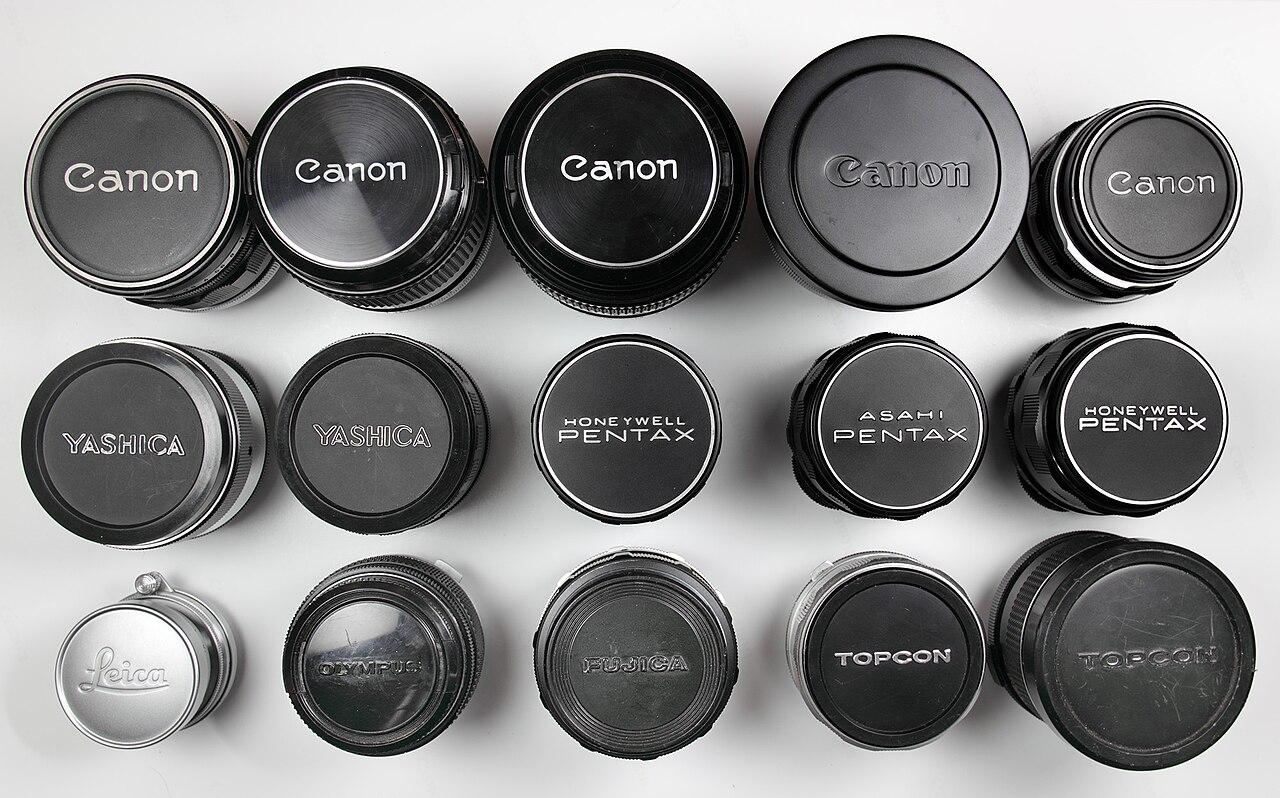
The same owner took every reading twice, once bare and once through a plastic lens cap. On the Takumar the cap cut the count from 26,838 to 12,512. More than half of what the probe saw at the glass was stopped by a plastic cap.
Distance does the rest. With fifteen of these lenses laid out on a table, his gamma probe half a metre above them read four to five times the normal background. One metre away it read about twice.
Walker found the same with a single lens. His room read 0.12 microsieverts an hour. Against the front element of his 1952 Summicron the meter read about 1.14, and against the rear about 1.51. A few centimetres away he measured little above the room.


What that means for a person
The United States nuclear regulator worked this out in a 2001 review, which the Oak Ridge museum summarises. The sources give millirem; we have converted to microsieverts, at ten to one.
Measurements gave about 0.1 microsievert an hour ten centimetres inside the body of someone carrying a camera with such a lens. A serious photographer carrying it six hours a day for thirty days a year would get about 20 microsieverts a year. An average photographer would get 7. With the highest thorium content the rules allow, 30 percent, those figures could triple.
For scale, the average person in the United States gets about 6,200 microsieverts a year from all sources, natural and medical. Twenty is about a third of one percent of that.
The same review looked at the worst case it could think of: a television camera operator standing behind three thoriated lenses for a thousand hours a year. That came to as much as 600 microsieverts a year, and the museum adds that there is no evidence such lenses were common in television cameras.
Measured in Stockholm
In 2013 two students at the Royal Institute of Technology in Stockholm, Jonathan Wäng and Viktor Henningsson, put eight lenses and three camera bodies in a germanium detector for at least eighteen hours each. They had picked lenses that made a simple Geiger counter react.
The one that stood out was a Carl Zeiss Tessar 80 mm f/2.8 from a Hasselblad 1000F. They put its total activity at 96 becquerels, give or take 10.
They then assumed a professional who holds the camera to the face for an hour a day, 240 days a year, and carries it eight hours a day. The dose to the lens of the eye came to under 3 microsieverts a year, against a Swedish limit of 15,000. The dose to the whole body came to 0.17 microsieverts, against a limit of 1,000 for the public. Both are about two ten-thousandths of the limit. Their conclusion was that none of the lenses they measured is a health hazard.
None of their eight lenses was a Takumar. We have not found a laboratory study that gives a dose for one, which is why the Takumar figures in this article are counts from one owner’s instrument and not doses.
Where it is a real problem
The eye, at close range. If thoriated glass is used in an eyepiece, the outer tissue of the eye sits right against it, for hours. The Oak Ridge museum cites an estimate for someone using an eyepiece with 16 percent thorium for twenty hours a week: 880 rem a year to the outermost tissue, which is 8.8 sieverts. That is a very large dose. American rules do not allow thorium in eyepieces, but the museum notes it has happened. Walker’s advice is to test the eyepieces of an old telescope or microscope, especially if the glass looks yellow.
The glass itself, once it is no longer whole. The American exemption that lets anyone own these lenses covers finished lenses only. It does not cover shaping, grinding or polishing them. Taking a thoriated element to the polishing wheel is the wrong repair to do at home.
Film, if it sits there long enough. The museum notes that the radiation from a lens with a lot of thorium can fog film left in the camera for a long time. Walker points out that in a camera with a focal-plane shutter, the closed shutter sits between the lens and the film.
The yellow tint
The radiation does one thing every owner can see. Over the decades it damages the glass it sits in, and the element turns yellow to reddish brown. Cooke describes it on the Speed Panchros as looking like a tea stain, strongest towards the centre, and says the 75 mm was the one that suffered most.
On black-and-white film it works like a weak yellow filter. On colour it shifts everything warm, and it costs some light.
The tint can be reduced with light. The picture at the top shows two identical Takumars that had yellowed equally; the middle one was then lit with an ultraviolet torch for several days. Clearing the tint does not remove the thorium. The lens is as radioactive afterwards as before, and thorium-232 has a half-life of about 14 billion years.
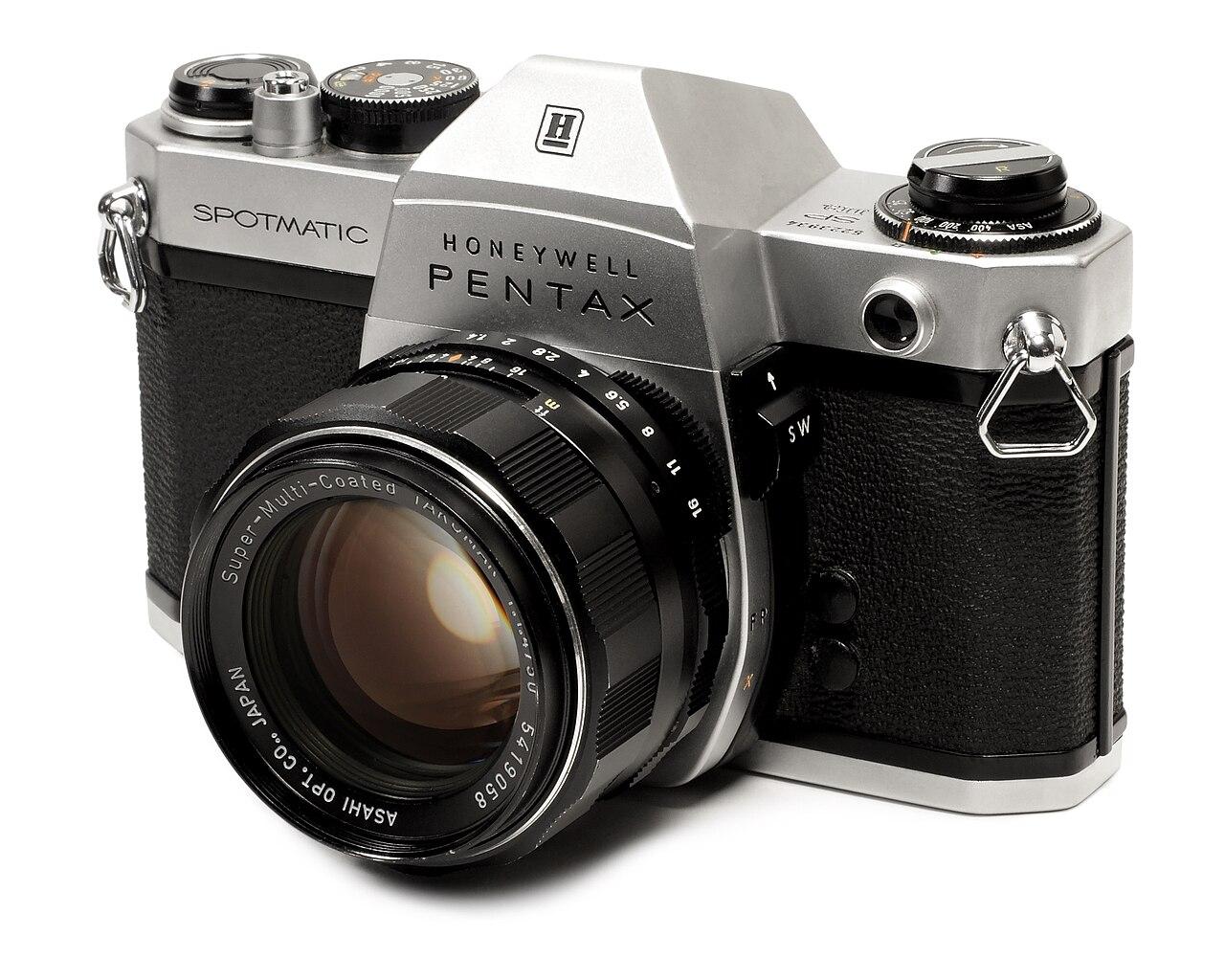
Photo: Evan-Amos · Public domain · Wikimedia Commons

A Takumar 50 mm f/1.4 on a Honeywell Pentax Spotmatic. The glass has gone amber.
Quick answers
- Is the Super-Takumar 50 mm f/1.4 radioactive?
- It is on the Oak Ridge museum’s list of camera lenses known to have contained thorium, together with the 35 mm f/2, the 55 mm f/1.8 and the 55 mm f/2. The list names models, not individual lenses.
- Is a radioactive lens dangerous to use?
- The estimates we found say no. The United States nuclear regulator put a serious photographer’s dose at about 20 microsieverts a year, around a third of one percent of the average yearly dose from all sources.
- Is the Super-Takumar the most radioactive lens?
- Not in the one side-by-side comparison we found. A Konica Hexanon 57 mm f/1.2, an early Fujinon 50 mm f/1.4 and a Canon FD 55 mm f/1.2 Aspherical all gave higher counts than the Takumar 50 mm f/1.4 on the same instrument.
- When is thorium glass a real risk?
- In an eyepiece, where the eye sits against the glass for hours, and when the glass is ground or polished.
- Does clearing the yellow tint make the lens less radioactive?
- No. Light reduces the tint, but the thorium stays in the glass.
Sources
- ORAU Museum of Radiation and Radioactivity: Thoriated Camera Lens (ca. 1970s), by Paul Frame
- Jonathan Wäng and Viktor Henningsson: An Analysis of Residual Radiation in Thoriated Camera Lenses (degree project, KTH Royal Institute of Technology, 2013)
- John Walker: A Radioactive Lens (Fourmilab, 2018)
- Cooke Optics: the history of the Speed Panchro
- US Patent 2,466,392: Optical Glass, Paul F. De Paolis, Eastman Kodak (filed 1945, granted 1949)
- US Environmental Protection Agency: Radiation Sources and Doses
- Wikipedia: Thoriated glass
- Wikimedia Commons: Radioactive Lenses (group shot), photograph and measurements by s58y
- Wikimedia Commons: 50mm f/1.4 S-M-C Takumar (Radioactive), photograph and description by s58y
- Wikimedia Commons: Yellowing of thorium lenses, photograph and description by El Grafo (2015)